
Pacific saury research
Weekly analysis of Taiwan-origin Pacific saury catches, season estimates and dated evidence on fish distribution. Follow the latest assessment, compare earlier issues and review the methods behind the figures.
Catch rebounds, fish signals in focus
A five-day research outlook for October 20–24 pairs modeled conditions with the Taiwan fleet’s last observed cells. Encounter probabilities around the fleet remain unvalidated.
Read the assessment →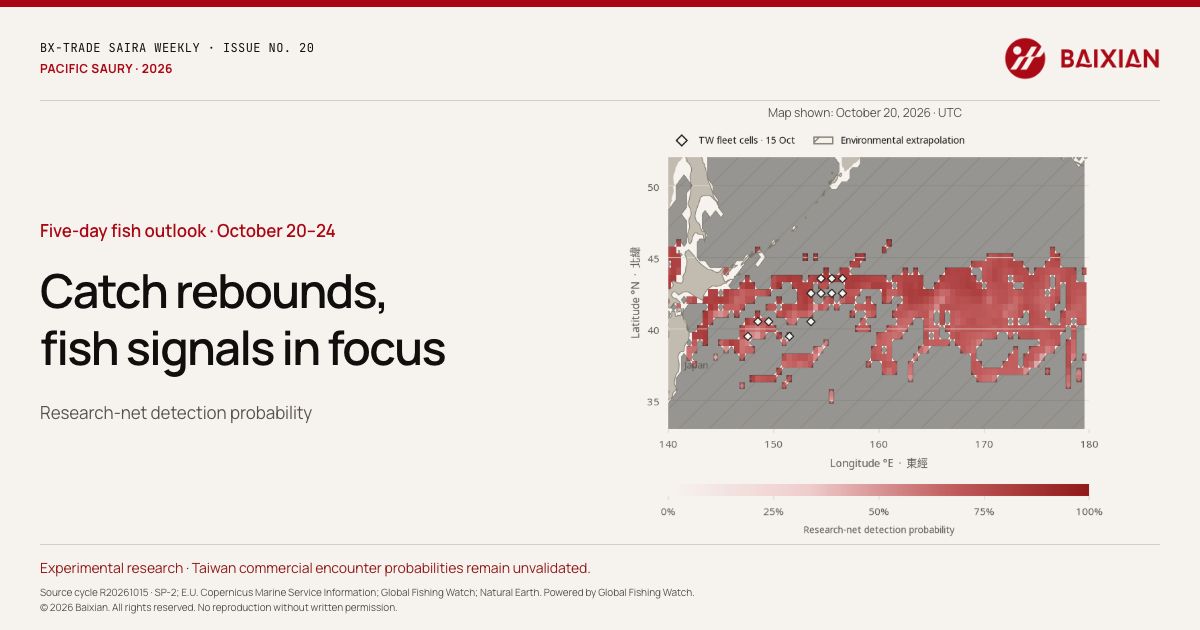
Choose your reading path
Catch and season outlook
Compare reported catch with the season estimate, its reporting cutoff and assumptions.
What to check
Published issues distinguish reported catches from estimates for the remaining season. Read each estimate with its reporting cutoff, fleet coverage, assumed end of operations and uncertainty range. A season estimate is not a prediction for an individual vessel or a single week.
Fish and fishing grounds
Distinguish survey evidence, fleet observations and research scenarios. Check their dates and validation limits.
What to check
Dated survey samples, observed fleet positions and ocean conditions provide different kinds of evidence. Vessel presence does not confirm fish presence. Experimental movement scenarios and unvalidated encounter probabilities are identified separately from issued catch estimates.
Methods and model updates
Review how estimates are built and which model developments remain under research.
What to check
The methodology explains the forecasting framework, comparison baselines and validation record. Weekly issues identify model developments and their limits, including changes that remain under research and have not entered the published estimates.
Report archive
4 reports
Catch rebounds, fish signals in focus
A five-day research outlook for October 20–24 pairs modeled conditions with the Taiwan fleet’s last observed cells. Encounter probabilities around the fleet remain unvalidated.
Pacific sauryCatch drops 54%: Where are the saury?
October samples confirm saury west of Taiwan’s observed fleet grounds. The season base case falls 17.0% to 21,819.3 MT; commercial fish encounter forecasts at those grounds still await validation.
Pacific saury2026 Pacific Saury Catch Trajectory and Season Outlook
How the Taiwan-origin season has developed, what the remaining path requires, and the assumptions and measured evidence behind the season outlook.
Pacific sauryWeekly catch rebounds as the season outlook softens
This week’s catch, the season outlook and the conditions to watch before the fleet’s assumed end-of-October return.
Pacific sauryReading the outlook
Which catches do the estimates cover?
The reports cover the Taiwan-origin fleet and the reporting population stated in each issue. These totals do not represent all Pacific saury catches, global fish abundance or Baixian’s own purchasing volume. Pacific saury’s scientific name is Cololabis saira.
Where can I find fish-presence forecasts?
Start with the latest issue’s fish and grounds discussion. It separates confirmed sampling locations from fleet observations and research scenarios. Where a fish-location or encounter forecast has not been validated, the report states that limitation rather than presenting it as established.
How should I compare weeks?
Use the issue date, reporting period and stated assumptions together. Each weekly issue preserves its own assessment; newer information does not silently replace the figures in an earlier issue.
About this research
Published by BX-TRADE Commodity Research & Strategy, part of Baixian’s global trading business. This is company-produced commodity research. Sources, assumptions and limitations accompany the analysis; forecasts remain uncertain.
Source organizations
Refer to each report for its specific sources and dates. These links lead to information published by the named organizations.