Dosidicus gigas
The Giant Squid — also Humboldt squid, jumbo flying squid, "pota" in Peru — is the most abundant cephalopod by volume in the Southeast Pacific, sustaining one of the world's largest cephalopod fisheries. Baixian Trade sources through a single seafrozen origin — Mainland China distant-water jigger operations in the Peru High Seas and the Eastern Equatorial Pacific High Seas — and three landfrozen routes: Peru and Chile partner-plant raw material; Calamari Steak processed at BXTW-FAC-1 (Kaohsiung) for North American foodservice; and our in-house Gigas processing line at BXGC-FAC-3 (Fuzhou) covering Cleaned Tubes, Rings, Carved Squid, Tentacles, and specialty cuts.
Taxonomy, distribution,
and stock management.
Taxonomy
- Kingdom
- Animalia
- Phylum
- Mollusca
- Class
- Cephalopoda
- Order
- Oegopsida
- Family
- Ommastrephidae
- Genus
- Dosidicus
- Species
- Dosidicus gigas
Distribution
Migratory cephalopod endemic to the eastern Pacific Ocean, ranging from southern Chile (≈45°S) through Peru, Ecuador, and the equatorial Pacific, with seasonal extension as far north as the California Current. Three biological size cohorts are recognised under the Nigmatullin (2001) / Keyl (2008) framework: a small-sized cohort predominating in the Eastern Equatorial Pacific, a medium-sized cohort distributed across the full range, and a large-sized cohort occurring at northern and southern latitudinal extremes. Baixian Trade's seafrozen catch comes from Mainland China distant-water jiggers operating in two high-seas zones — the Peru High Seas (outside the Peru EEZ, large cohort — component supply for the trade) and the Eastern Equatorial Pacific High Seas (outside the Ecuadorian and northern Peruvian EEZs, small cohort — baby-giant whole round). Landfrozen raw material flows from Peru and Chile partner plants processing artisanal-fleet catch within their respective EEZs.
Stock & management
Stock assessed under IMARPE (Peru) and IFOP (Chile) authority within their respective EEZs; managed by the South Pacific Regional Fisheries Management Organisation (SPRFMO) in international waters, with Asian distant-water fleet effort frozen at 2020 levels in 2023 and cut further in 2026.
Peru's annual catch quota set by PRODUCE on IMARPE recommendation — 499,683 MT in 2024; for 2026, the LMCTP was set initially at 305,417 MT for January–June, then raised in stages to 709,659 MT for the full year (RM 00304-2026-PRODUCE, August 2026). The fishery operates year-round across origins rather than under a hard closed season. The Mainland China distant-water fleet rotates seasonally between two high-seas zones — the Eastern Equatorial Pacific High Seas (fished Jan–Apr) and the Peru High Seas outside the Peru EEZ (fished May–Dec). Peru EEZ artisanal/coastal-fleet catch is continuous, with quota-defined annual peaks driven by ENSO state and cohort migration.
One seafrozen origin. Three landfrozen routes.
Dosidicus gigas reaches our buyers through one seafrozen catch origin — Mainland China distant-water jigger operations in international waters — and three landfrozen routes: Peru and Chile partner-plant raw material; Calamari Steak processed at BXTW-FAC-1 (Kaohsiung) for North American foodservice; and our in-house Gigas processing line at BXGC-FAC-3 (Fuzhou) serving global markets. The fleet that catches it, where it's caught, and where it's processed all change the product specification. We surface the difference at the line-item level rather than treating Gigas as a single SKU. All landfrozen processed products at both facilities are available EU-treated or non-treated at the buyer's choice, reflected in the unit price. EU-treated product is treated to EU market specifications; details on request.
Mainland China distant-water jigger fleet — two operating zones
Mainland China origin distant-water jiggers operating in international waters under SPRFMO Vessel List authorisation and flag-state reporting. The fleet works two structurally distinct zones producing two structurally distinct raw material categories:
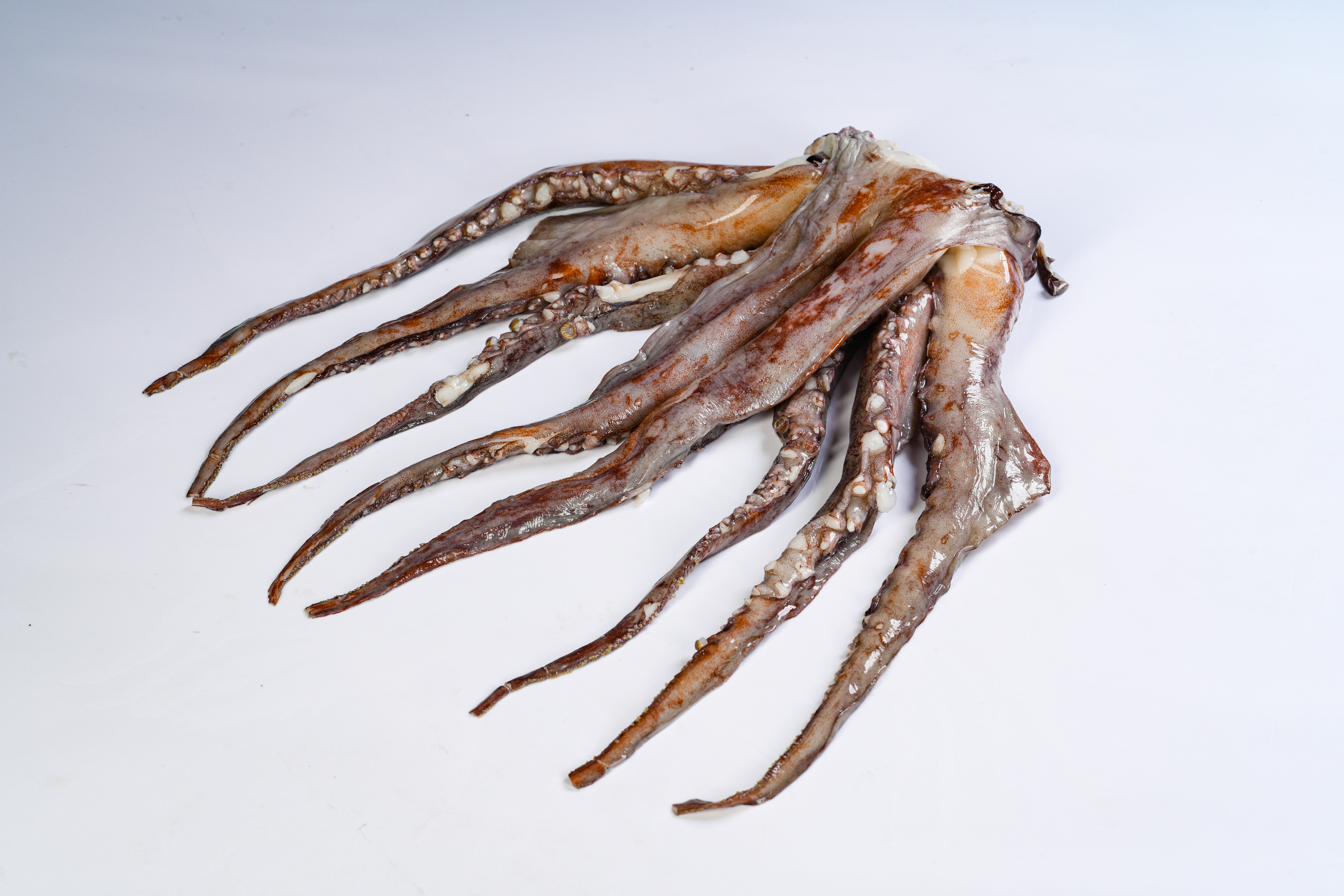
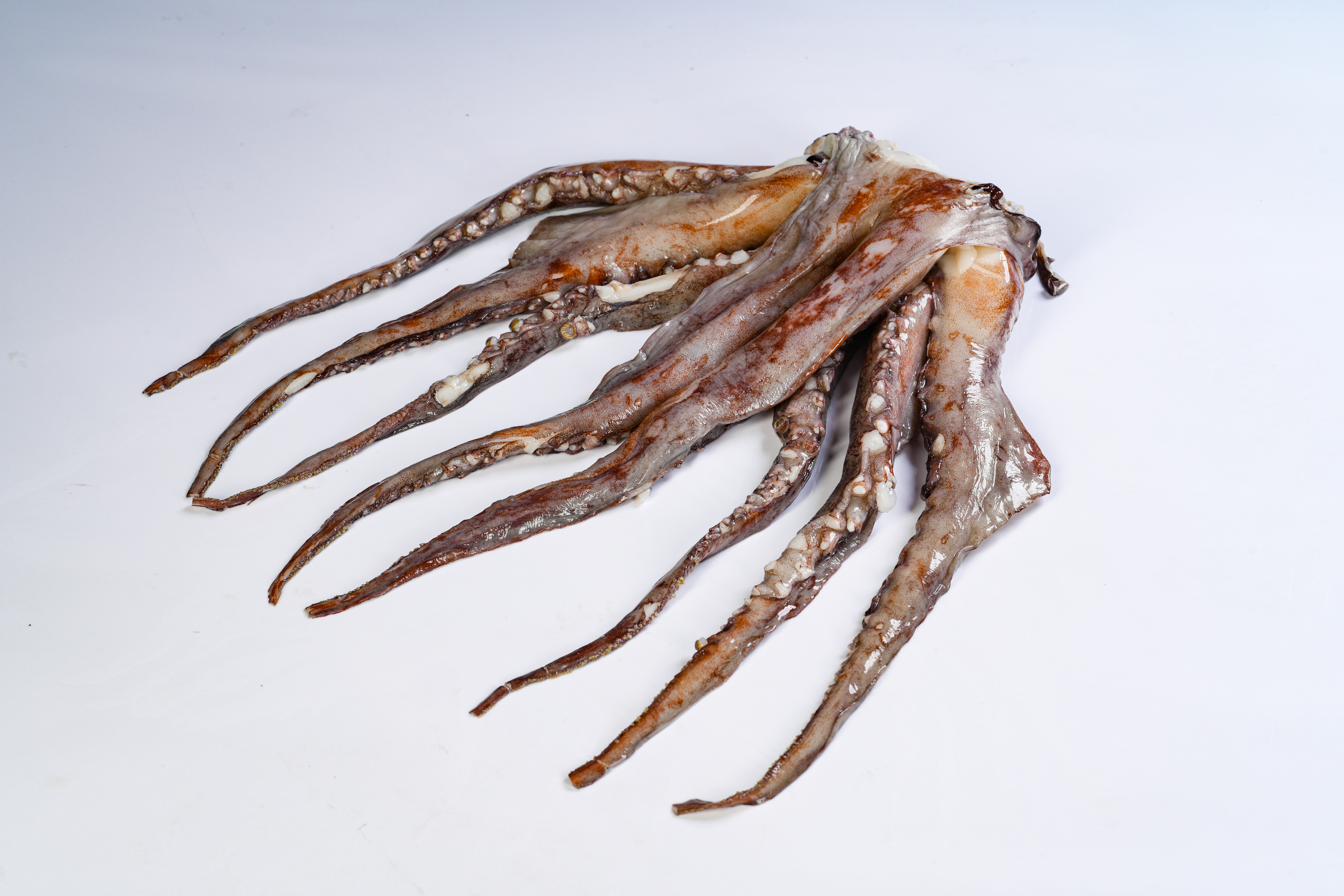
Peru High Seas — component supply. The adult-cohort fishing ground in international waters off Peru produces the large-sized cohort under the Keyl et al. 2008 framework, whose mature animals can reach 1,000–1,200mm mantle length. The commercial catch here commonly runs 4–5kg+ whole weight — too large to sea-freeze whole, so vessels divide each catch into Wings, Tentacles (3-OFF — Neck, Eyes, Beak OFF — also known in the trade as Dirty Tentacles), and Skin-ON Fillets, and sea-freeze each component separately at vessel.
Eastern Equatorial Pacific High Seas — whole round. The high-seas fishing ground outside the Ecuadorian and northern Peruvian EEZs produces the small-sized cohort — "baby giant squid", which matures at 130–340mm mantle length — small enough to sea-freeze as Whole Round. Commercial whole-round sizes run from 300–500g through 2–4kg.
Mainland China origin sea-frozen Gigas distributes globally — across East Asia, EU, North America, Latin America, MENA, and the CIS. The two raw material categories serve different downstream uses: the component supply feeds both direct-retail and further-processing channels (including our own BXGC and BXTW lines); the equatorial whole round serves whole-fish presentation, further cutting, and processed-food production.
- Fleet
- Mainland China origin distant-water jiggers SPRFMO Vessel List authorised; flag-state reporting
- Vessel count
- ~528 active vessels2024 SPRFMO area (largest by far); SPRFMO limit 570 (CMM 18-2026)
- Processing
- Sea-frozen at vessel; onward landfrozen value-added available at BXTW-FAC-1 and BXGC-FAC-3
- Plant references
-
BXGC-FAC-3 3500/02246 EU listedlandfrozen processing · also GACC-registered · MFDS-listed
BXTW-FAC-1 7FH0043 EU listedlandfrozen processing (Calamari Steak line) - Season
- Year-roundcohort-shifted peaks; equatorial Jan–Apr, Peru High Seas May–Dec
- Primary forms
-
Component supply Wings (SF) · Tentacles 3-OFF (SF) · Skin-ON Fillets (SF)
Equatorial whole round Whole Round (SF) - Incoterms
- FOB Fuzhou defaultCFR / CIF / DDP available
The adult-cohort animal is divided at vessel into Wings, Tentacles, and Skin-ON Fillets, each sea-frozen separately. All sea-frozen output is block frozen at vessel and packed in woven bags; bag weight is fixed or non-fixed depending on vessel. Size bands below reflect 2025 fleet landing distribution; actual ranges vary by vessel and trip.
| Size band | Specification |
|---|---|
| 30–50g | BlockWoven bagFixed or non-fixed weight (vessel-dependent)Sea-frozen at vessel |
| 50–100g | BlockWoven bagFixed or non-fixed weight (vessel-dependent)Sea-frozen at vessel |
| 100–300g | BlockWoven bagFixed or non-fixed weight (vessel-dependent)Sea-frozen at vessel |
| 300–500g | BlockWoven bagFixed or non-fixed weight (vessel-dependent)Sea-frozen at vessel |
| 500–1000g | BlockWoven bagFixed or non-fixed weight (vessel-dependent)Sea-frozen at vessel |
| 1KG UP | BlockWoven bagFixed or non-fixed weight (vessel-dependent)Sea-frozen at vessel |
| Size band | Specification |
|---|---|
| 50–100g | BlockWoven bagFixed or non-fixed weight (vessel-dependent)3-OFF |
| 100–300g | BlockWoven bagFixed or non-fixed weight (vessel-dependent)3-OFF |
| 300–500g | BlockWoven bagFixed or non-fixed weight (vessel-dependent)3-OFF |
| 500–1000g | BlockWoven bagFixed or non-fixed weight (vessel-dependent)3-OFF |
| 1–2KG | BlockWoven bagFixed or non-fixed weight (vessel-dependent)3-OFF |
| 2KG UP | BlockWoven bagFixed or non-fixed weight (vessel-dependent)3-OFF |
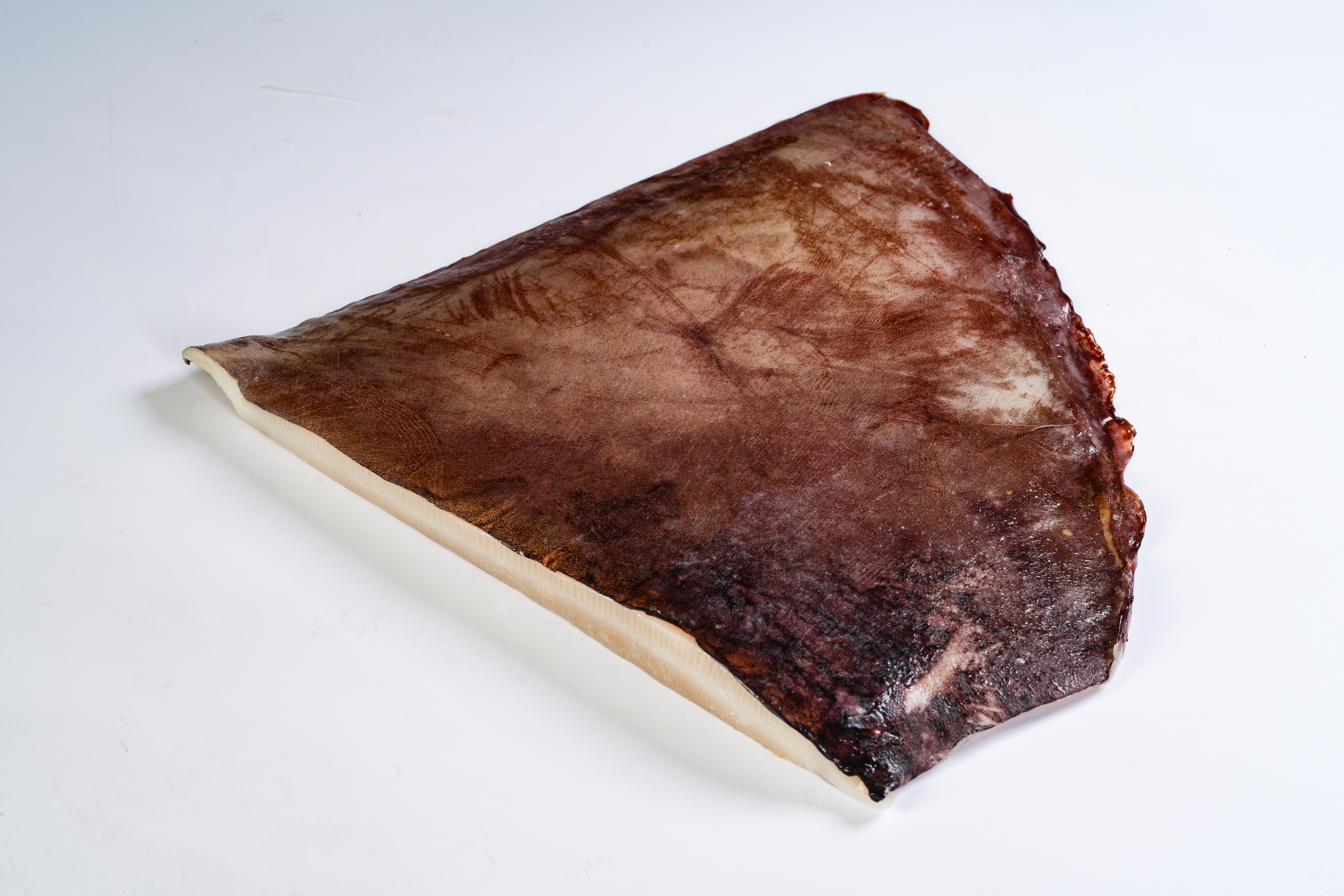
Skin-ON is the standard for sea-frozen output because skin removal is impractical at vessel. Distinct from Illex Dirty Tube — Illex Dirty Tube arrives gutted and ready for downstream cutting, while these Gigas Skin-ON Fillets are the seafrozen raw material with skin retained. Partner-plant Gigas (Peru and Chile) is supplied as Skin-OFF Fillets instead.
| Size band | Specification |
|---|---|
| 100–300g | BlockWoven bagFixed or non-fixed weight (vessel-dependent)Skin-ON |
| 300–500g | BlockWoven bagFixed or non-fixed weight (vessel-dependent)Skin-ON |
| 500–1000g | BlockWoven bagFixed or non-fixed weight (vessel-dependent)Skin-ON |
| 1000–2000g | BlockWoven bagFixed or non-fixed weight (vessel-dependent)Skin-ON |
The equatorial cohort is structurally smaller — "baby giant squid" — and sea-frozen as Whole Round at vessel. All output is block frozen and packed in woven bags; bag weight is fixed or non-fixed depending on vessel.
| Size band | Specification |
|---|---|
| 300–500g | BlockWoven bagFixed or non-fixed weight (vessel-dependent)Sea-frozen at vessel |
| 500–1000g | BlockWoven bagFixed or non-fixed weight (vessel-dependent)Sea-frozen at vessel |
| 1000–2000g | BlockWoven bagFixed or non-fixed weight (vessel-dependent)Sea-frozen at vessel |
| 2000–4000g | BlockWoven bagFixed or non-fixed weight (vessel-dependent)Sea-frozen at vessel |
Peru and Chile partner-plant — raw material
Peruvian and Chilean partner-plant Gigas raw material — sourced from local artisanal and coastal fleets operating within their respective EEZs, processed at partner plants, and traded by Baixian Trade as semi-finished raw material. Distinguished from Mainland China sea-frozen output by two operationally consequential cut-state differences:
Skin-OFF Fillets. Sea-frozen fillets retain the skin because skin removal is impractical at vessel; partner-plant fillets can be produced Skin-OFF, which serves retail and downstream processing channels.
5-OFF Cleaned Tentacles. Sea-frozen tentacles typically reach 3-OFF (Neck/Eyes/Beak OFF). The additional cleaning steps — Sexual Tentacles OFF, Nails-OFF, and Suckers-OFF — require the labour and water capacity that only partner plants can provide. The 5-OFF product is the cleanest tentacle form Gigas reaches in the international market.
The Peruvian fishery is the second-most-important fishery in Peru after anchoveta, with the 2024 PRODUCE quota set at 499,683 MT. Peruvian and Chilean origin landfrozen Gigas primarily serves East Asian buyers for both direct retail/foodservice and as raw material for our own downstream BXGC processing line. Baixian Trade also distributes Peru/Chile origin raw material via third-party trade to Southeast Asia, the CIS, and select other global destinations through our trade team.
- Fleet
- Peru artisanal + Chile artisanal ~3,400+ formalised PE artisanal vessels (2024); CL industrial fleet: bycatch only since 2019
- Latest catch
- Peru ~521,000 MT (2025 through Oct 1) + Chile ~85,000 MT (H1 2025)IMARPE / IFOP; recovery from 2024 El Niño trough; subject to continued ENSO-driven variation
- Processing
- Land-frozen at Peru and Chile partner plantsHACCP-certified · EU-listed partner plants
- Plant references
- Peru EU-listed processors (per consignment)
Chile EU-listed processors (per consignment)Plant references provided at the quote stage per consignment routing - Raw size ranges
- 0.5–1KG · 1–1.5KG · 1.5–2KG · 2–3KG · 3–4KG · 4–5KG · 5–6KG · 6–7KG · 7–8KG · 8–9KG · 9–10KGfull landing-curve coverage from artisanal/coastal fleet
- Pack formats
- 2×10KG · 3×8KG · 3×7.5KG · 3×7KG · 3×6.5KG · 4×7.5KGvaries by partner plant; woven bag or carton
- Season
- Year-roundPeru EEZ catch peaks Q2–Q3; Chile EEZ catch peaks Q3–Q4
- Primary forms
- Skin-OFF Fillets (LF) · Semi-Cleaned Tentacles 4-OFF (LF) · Cleaned Tentacles 5-OFF (LF) · Wings (LF) · Dirty Tubes (LF) · Necks · Bits and Pieces · Buttons · Rings · Strips · Sexual Tentacles · Cones (Skin-ON / Skin-OFF)
- Incoterms
- CFR Asia ports (default)FOB Peru / Chile · CIF / DDP on request
The product line below reflects standard offerings across Peruvian and Chilean partner plants. All raw material is block frozen and packed in either woven bag or carton, with the pack format varying by partner plant — common formats include 2×10KG, 3×8KG, 3×7.5KG, 3×7KG, 3×6.5KG, and 4×7.5KG. The 5-OFF Cleaned Tentacles and Skin-OFF Fillets are the operationally distinctive forms versus Mainland China sea-frozen: skin-OFF and the additional 5-OFF cleaning steps require labour and water capacity only available at partner plants.
| Size band | Specification |
|---|---|
| 300–500g | BlockWoven bag or cartonSkin-OFF · land-frozen at partner plant |
| 500–1000g | BlockWoven bag or cartonSkin-OFF · land-frozen at partner plant |
| 1–2KG | BlockWoven bag or cartonSkin-OFF · land-frozen at partner plant |
| 2–4KG | BlockWoven bag or cartonSkin-OFF · land-frozen at partner plant |
| 4KG UP | BlockWoven bag or cartonSkin-OFF · land-frozen at partner plant |
| Size band | Specification |
|---|---|
| 50–100g | BlockWoven bag or carton4-OFF Semi-Cleaned · land-frozen at partner plant |
| 100–300g | BlockWoven bag or carton4-OFF Semi-Cleaned · land-frozen at partner plant |
| 300–500g | BlockWoven bag or carton4-OFF Semi-Cleaned · land-frozen at partner plant |
| 500–1000g | BlockWoven bag or carton4-OFF Semi-Cleaned · land-frozen at partner plant |
| 1–2KG | BlockWoven bag or carton4-OFF Semi-Cleaned · land-frozen at partner plant |
| 2KG UP | BlockWoven bag or carton4-OFF Semi-Cleaned · land-frozen at partner plant |
| Size band | Specification |
|---|---|
| 50–100g | BlockWoven bag or carton5-OFF Cleaned · land-frozen at partner plant |
| 100–300g | BlockWoven bag or carton5-OFF Cleaned · land-frozen at partner plant |
| 300–500g | BlockWoven bag or carton5-OFF Cleaned · land-frozen at partner plant |
| 500–1000g | BlockWoven bag or carton5-OFF Cleaned · land-frozen at partner plant |
| 1–2KG | BlockWoven bag or carton5-OFF Cleaned · land-frozen at partner plant |
| 2KG UP | BlockWoven bag or carton5-OFF Cleaned · land-frozen at partner plant |
| Size band | Specification |
|---|---|
| 100–300g | BlockWoven bag or cartonWings ON · land-frozen at partner plant |
| 300–500g | BlockWoven bag or cartonWings ON · land-frozen at partner plant |
| 500–1000g | BlockWoven bag or cartonWings ON · land-frozen at partner plant |
| 1000–2000g | BlockWoven bag or cartonWings ON · land-frozen at partner plant |
| Size band | Specification |
|---|---|
| 300g UNDER | BlockWoven bag or cartonSkin-ON · land-frozen at partner plant |
| 300–500g | BlockWoven bag or cartonSkin-ON · land-frozen at partner plant |
| 500–1000g | BlockWoven bag or cartonSkin-ON · land-frozen at partner plant |
| 1–2KG | BlockWoven bag or cartonSkin-ON · land-frozen at partner plant |
| 2KG UP | BlockWoven bag or cartonSkin-ON · land-frozen at partner plant |
| Form | Specification |
|---|---|
| Necks (100/300g) | BlockWoven bag or carton |
| Necks (300/500g) | BlockWoven bag or carton |
| Necks (500g UP) | BlockWoven bag or carton |
| Bits and Pieces | BlockWoven bag or carton |
| Buttons | BlockWoven bag or carton |
| Rings (Outer Ø 5–7.5cm · Inner Ø 2.2–5cm · Thickness 0.8–1.6cm) | BlockWoven bag or carton |
| Strips | BlockWoven bag or carton |
| Sexual Tentacles (50CM UNDER) | BlockWoven bag or carton |
| Sexual Tentacles (50CM UP) | BlockWoven bag or carton |
| Cones (Skin-ON) | BlockWoven bag or carton |
| Cones (Skin-OFF) | BlockWoven bag or carton |
Processed at Kaohsiung — Calamari Steak
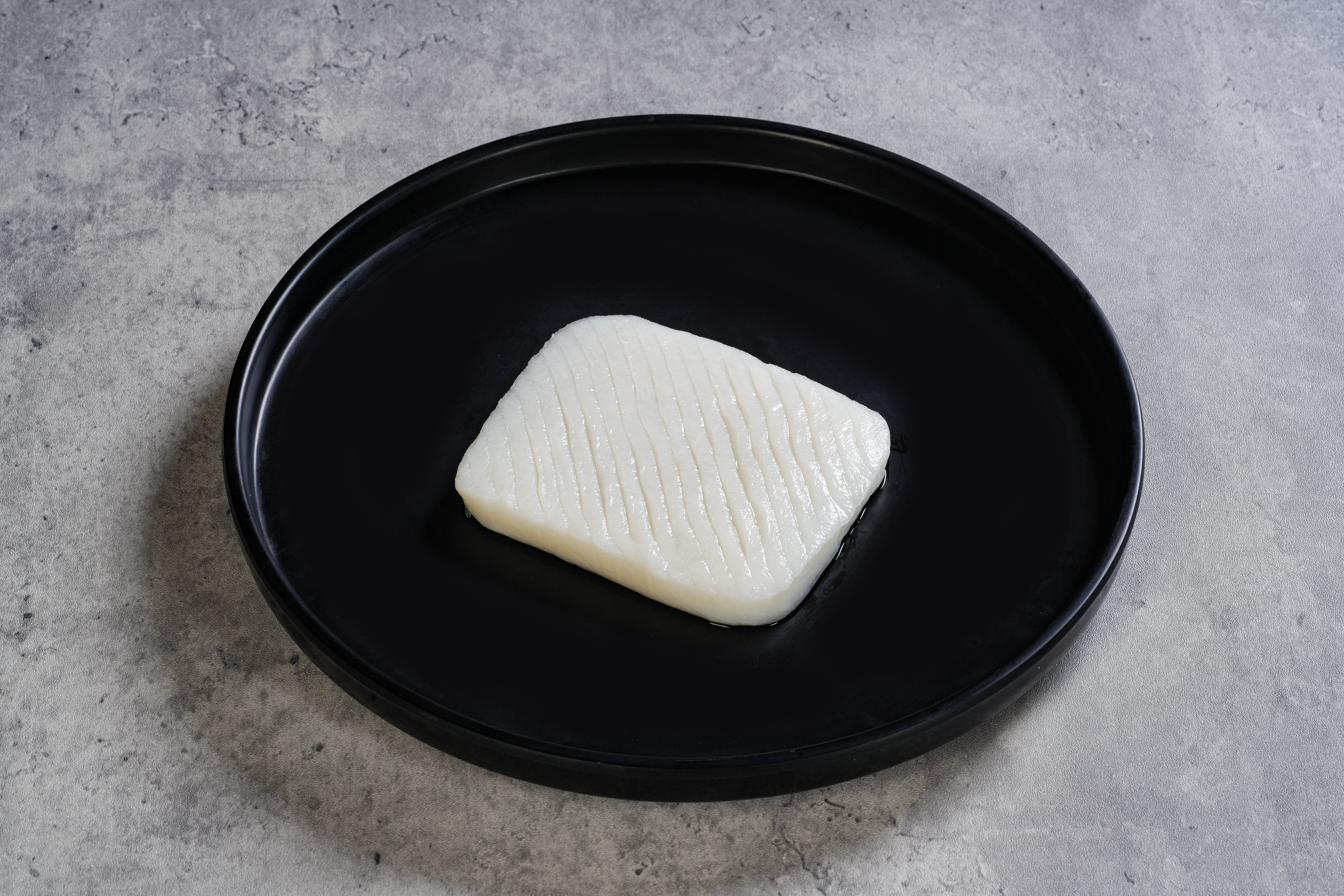
Mainland China sea-frozen and Peru/Chile partner-plant Gigas raw material — landed at BXTW-FAC-1 (Kaohsiung Qianzhen) for landfrozen value-added processing into Calamari Steak (also known in the US trade as Giant Squid Steak) — the standard US trade naming convention used by major US foodservice distributors. The product is a precision-cut rectangular piece sized to North American foodservice convention.
Cut specification: Length 9–11cm × Width 7–9cm × Thickness 1.3–1.8cm. Two size grades: 4–5 OZ (113–142g/pc) and 5–6 OZ (142–170g/pc). Available in regular and trimmed-edge variants.
Three pack formats reflect different US foodservice distribution channels — 36LB (6LB×6/carton) for retail-club and high-volume foodservice, 30LB (6LB×5/carton) for foodservice distribution, and 10KG (1kg×10/carton) blank-bag for re-packing distributors. All pack formats are customisable per buyer specification — bag/carton size, glazing percentage, and net weight adjusted at the inquiry stage.
The product targets primarily North American foodservice — US and Canada — with the OZ-based sizing convention and rectangular cut serving the US retail-foodservice channel directly. Chain-restaurant calamari programmes and foodservice distributors are the primary buyers.
- Source raw material
- Mainland China sea-frozen Skin-ON Fillets; Peru/Chile partner-plant Skin-OFF Filletsraw material origin specified at the inquiry stage
- Processing facility
- BXTW-FAC-1 7FH0043 EU listedKaohsiung Qianzhen · HACCP-certified
- Process
- Trimmed · graded · IQFEU-treated or non-treated at buyer's choice
- Availability
- Year-roundbuffer inventory at BXTW-FAC-2 cold storage
- Forms
- Calamari Steak (rectangular) · regular and trimmed-edge variants
- Sizes
- 4–5 OZ (113–142g/pc) · 5–6 OZ (142–170g/pc)9–11cm L × 7–9cm W × 1.3–1.8cm thick
- Pack formats
-
36LB 6LB × 6/carton
30LB 6LB × 5/carton
10KG 1kg × 10/carton customisable per buyer specification - Incoterms
- FOB Kaohsiung defaultCFR / CIF / DDP available
All variants are customisable on packaging, freezing format, glazing percentage, and net weight adjustability. Default specifications shown below; buyers can specify alternative pack sizes, glaze ranges, or freezing format at the inquiry stage.
| Grade · pack | Specification |
|---|---|
| 4–5 OZ (113–142g/pc) · 36LB (6LB×6/carton) | IQFNet weight 70–100% adj.Glaze 0–30% adj. |
| 5–6 OZ (142–170g/pc) · 36LB (6LB×6/carton) | IQFNet weight 70–100% adj.Glaze 0–30% adj. |
| 4–5 OZ (113–142g/pc) · 30LB (6LB×5/carton) | IQFNet weight 70–100% adj.Glaze 0–30% adj. |
| 5–6 OZ (142–170g/pc) · 30LB (6LB×5/carton) | IQFNet weight 70–100% adj.Glaze 0–30% adj. |
| 4–5 OZ (113–142g/pc) · 10KG (1kg×10/carton) | IQFNet weight 70–100% adj.Glaze 0–30% adj. |
| 5–6 OZ (142–170g/pc) · 10KG (1kg×10/carton) | IQFNet weight 70–100% adj.Glaze 0–30% adj. |
| Grade · pack | Specification |
|---|---|
| 4–5 OZ (113–142g/pc) · 36LB (6LB×6/carton) | IQFNet weight 70–100% adj.Glaze 0–30% adj. |
| 5–6 OZ (142–170g/pc) · 36LB (6LB×6/carton) | IQFNet weight 70–100% adj.Glaze 0–30% adj. |
| 4–5 OZ (113–142g/pc) · 10KG (1kg×10/carton) | IQFNet weight 70–100% adj.Glaze 0–30% adj. |
| 5–6 OZ (142–170g/pc) · 10KG (1kg×10/carton) | IQFNet weight 70–100% adj.Glaze 0–30% adj. |
Processed at Fuzhou — in-house Gigas processing line
Peru- and Chile-origin Gigas raw material — supplemented by Mainland China equatorial whole-round for select SKUs — landed at BXGC-FAC-3 (Fuzhou Mawei) for landfrozen value-added processing on our in-house Gigas processing line. The plant carries the most extensive Gigas processing range we operate, structured around several form families: Cleaned Tubes (Tip-ON and Tip-OFF variants with multiple net-weight and glaze tiers), Rings, Carved Squid (treatment variants), whole-round derived Dirty Tube Cut-Open and Tentacles forms, Skin-OFF Fillets, Crispy Tentacles, and a Specialty Cuts range covering Tentacles, Wings, Wheel-roll Squid, Paper-thin Squid, and Hot-pot Squid.
Carved Squid — also known in the trade as flower-cut or pineapple-cut squid — is one of our signature specialties. The product is pattern-cut on the surface to produce the characteristic carved presentation, then offered in three treatment variants (low, medium, high) for downstream channel-fit, plus an unblanched medium variant. Standard cut is 4 × (3–6)cm; IQF pack.
Whole-round derived forms — Dirty Tube Cut-Open and matched Tentacles — use Mainland China equatorial whole-round raw and are produced in either EU-treated or non-treated variants depending on buyer preference. The "Indian Ocean" equivalent uses Sthenoteuthis oualaniensis raw rather than Dosidicus gigas.
The line serves global markets, with depth in East Asian processed-food channels (hot-pot, retail-pack ready-to-eat, and downstream further-processing) and our trade team extending to Southeast Asia, the CIS, and select other destinations.
- Source raw material
- Primarily Peru/Chile partner-plant LF; supplementary Mainland China equatorial WR for select SKUsIndian Ocean Sthenoteuthis raw material processed on the same line
- Processing facility
- BXGC-FAC-3 3500/02246 EU listedFuzhou Mawei · also GACC-registered · MFDS-listed · HACCP-certified
- Process
- Trimmed · cut · carved (where applicable) · graded · packedEU-treated or non-treated at buyer's choice
- Availability
- Year-roundbuffer inventory at BXGC Fuzhou cold storage facility
- Forms
- Cleaned Tubes (Tip-ON / Tip-OFF) · Rings · Carved Squid (treatment variants) · Dirty Tube Cut-Open · Tentacles · Skin-OFF Fillets · Crispy Tentacles · Specialty Cuts (Tentacles, Wings, Wheel-roll Squid, Paper-thin Squid, Hot-pot Squid)
- Incoterms
- FOB Fuzhou defaultCFR / CIF / DDP available
All processed products at BXGC-FAC-3 are customisable on packaging, freezing format, glazing percentage, and net weight adjustability. Default specs shown below; buyers can specify alternative pack sizes, glaze ranges, or freezing format at the inquiry stage.
| Size band | Specification |
|---|---|
| 100–150g/pc · IQF pack | IQFNet weight 50–70% adj.Glaze 30–50% |
| 150–300g/pc · IQF pack | IQFNet weight 80–100% adj.Glaze 10–20% |
| 150–300g/pc · Interleaved / S.P. | BlockNet weight 50–100% adj.Glaze 0–50% |
| 300–400g/pc · diameter 10–12cm · Interleaved / S.P. | BlockNet weight 50–100% adj.Glaze 0–50% |
| Size band | Specification |
|---|---|
| 200–400g/pc · diameter 10–12cm · tip diameter 5–6cm · Interleaved / S.P. | Block & IQFNet weight 50–100% adj.Glaze 0–50% |
| Spec | Specification |
|---|---|
| Diameter 3–10cm | IQFNet weight 50–100% adj.Glaze 0–50% |
| Variant · treatment · cut | Specification |
|---|---|
| Low treatment · blanched · 4 × (3–6)cm | IQFNet weight 50–100% adj.Glaze 0–50% |
| Medium treatment · blanched · 4 × (3–6)cm | IQFNet weight 50–100% adj.Glaze 0–50% |
| High treatment · blanched · 4 × (3–6)cm | IQFNet weight 50–100% adj.Glaze 0–50% |
| Medium treatment · unblanched · 4 × (3–6)cm | IQFNet weight 100% |
| Raw material · treatment | Specification |
|---|---|
| Equatorial 300–500g · non-treated | BlockNet weight 90–100% adj. |
| Equatorial 300–500g · EU-treated | BlockNet weight 90–100% adj. |
| Raw material · treatment | Specification |
|---|---|
| Equatorial 300–500g · non-treated | BlockNet weight 90–100% adj. |
| Equatorial 300–500g · EU-treated | BlockNet weight 90–100% adj. |
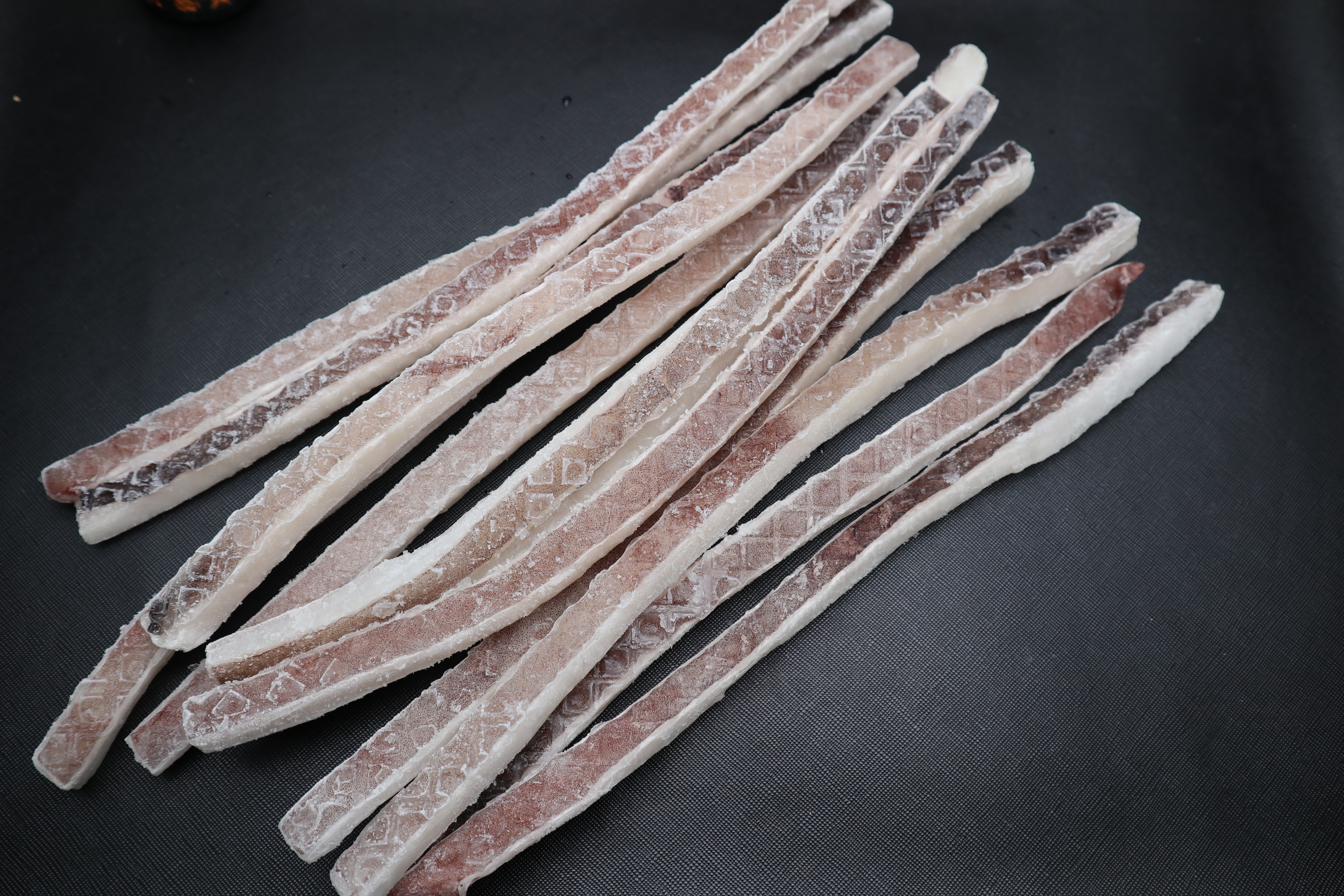
| Raw material · cut | Specification |
|---|---|
| Equatorial 300–500g processed · 0.8–1.0cm strips | BlockNet weight 90–100% adj.Glaze 0–10% |
| Equatorial 500–1000g processed · 0.8–1.0cm strips | BlockNet weight 90–100% adj.Glaze 0–10% |
| Variant | Specification |
|---|---|
| Skin-OFF · no de-acidification · no treatment | BlockNet weight 100% |
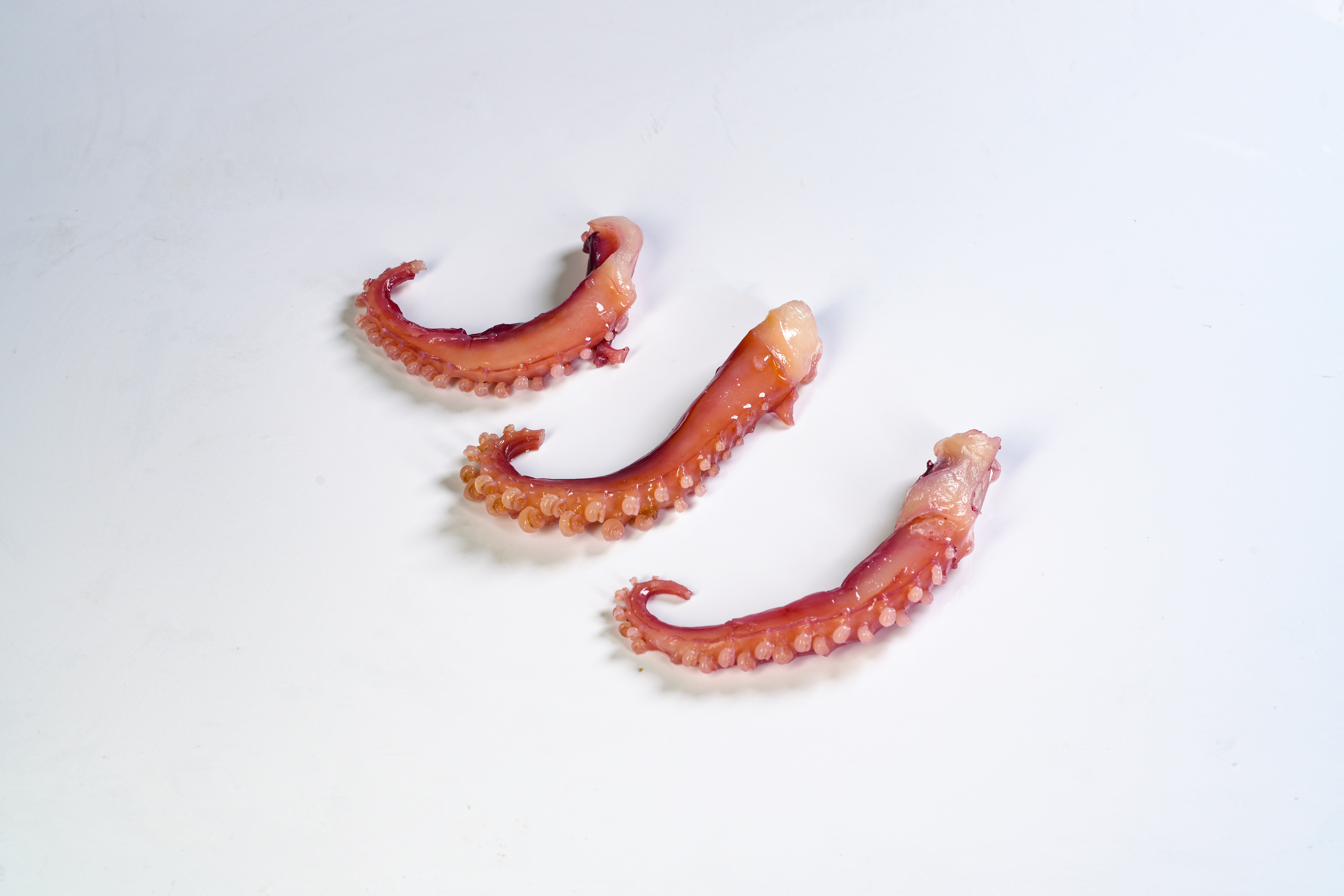
| Size band | Specification |
|---|---|
| 30–60g/pc | IQFNet weight 70–100% adj.Glaze 0–30% |
| 100–150g/pc | IQFNet weight 70–100% adj.Glaze 0–30% |
| 200–300g/pc | IQFNet weight 70–100% adj.Glaze 0–30% |
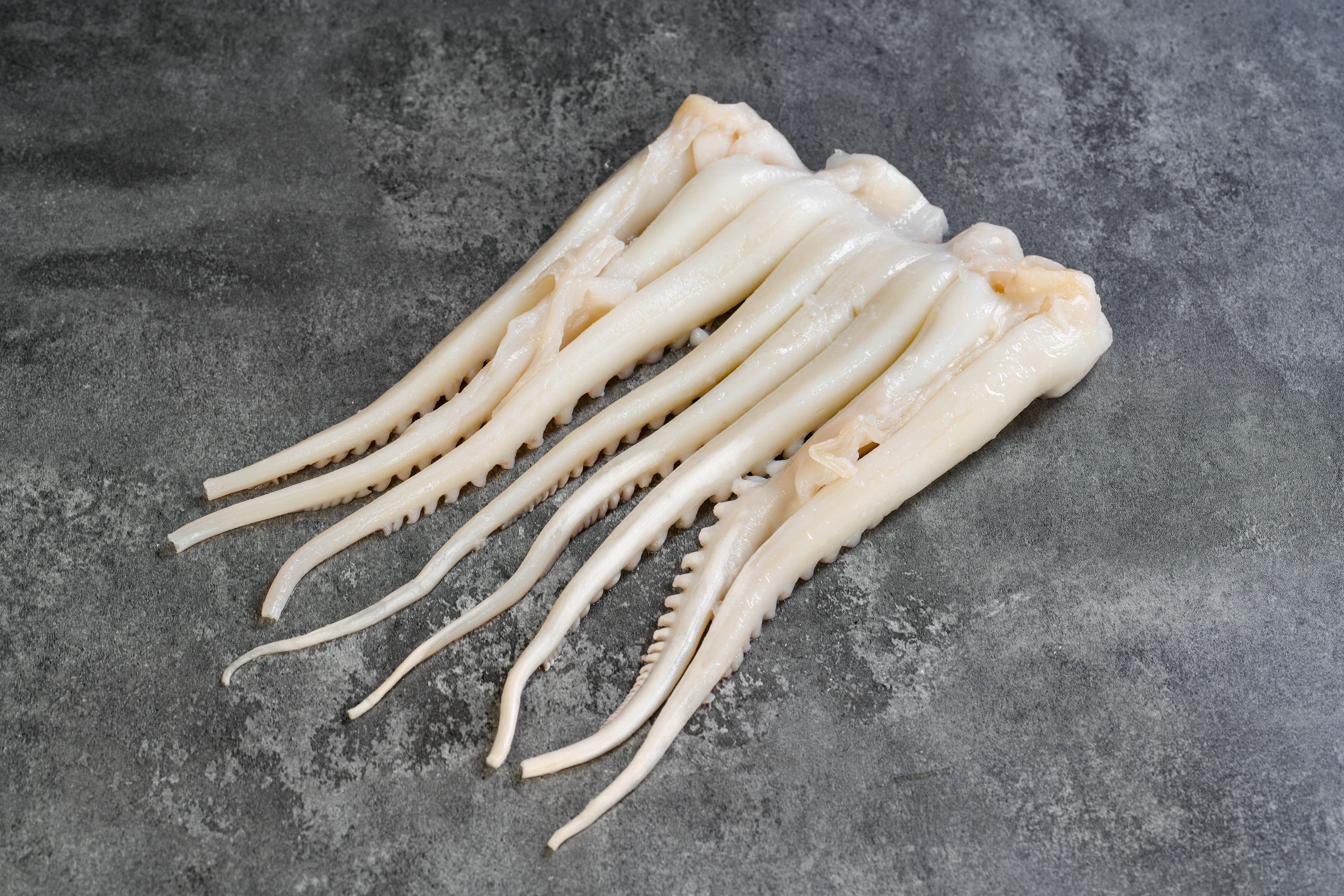
| Form | Specification |
|---|---|
| Tentacles · Skin-OFF | BlockNet weight 100% |
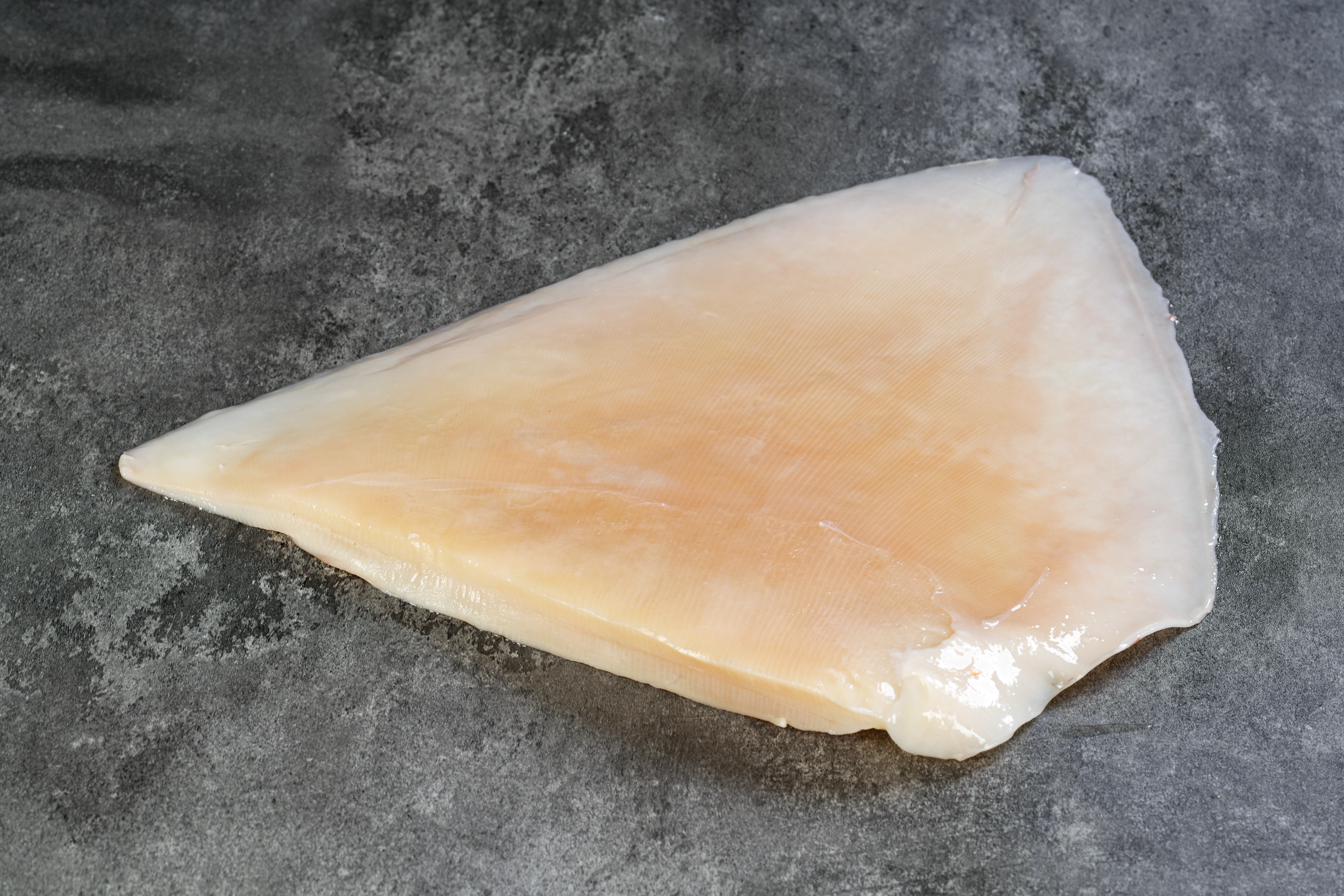
| Form | Specification |
|---|---|
| Wings · Skin-OFF | BlockNet weight 100% |
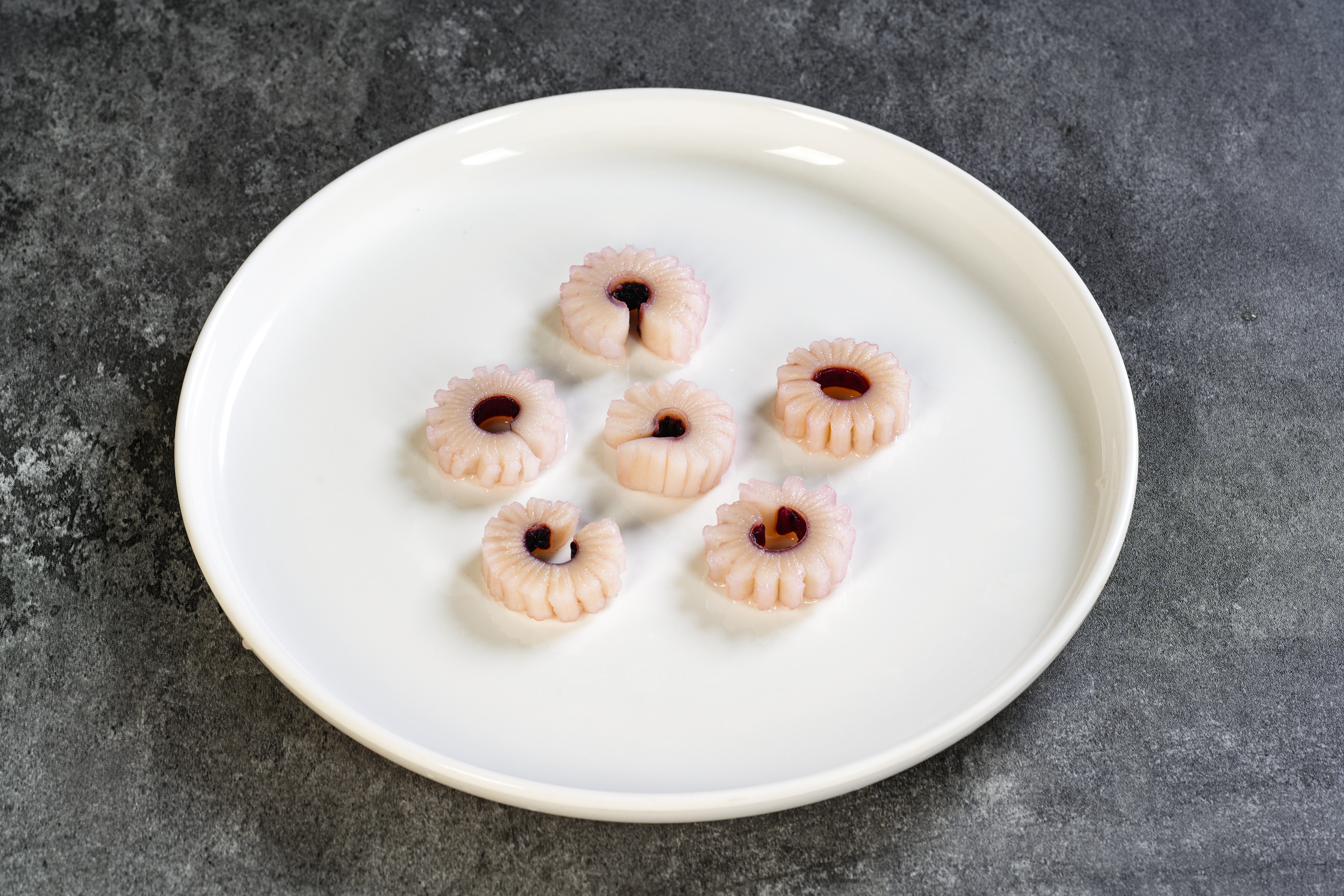
| Form | Specification |
|---|---|
| Wheel-roll Squid | IQFNet weight 70–100% adj.Glaze 0–30% |
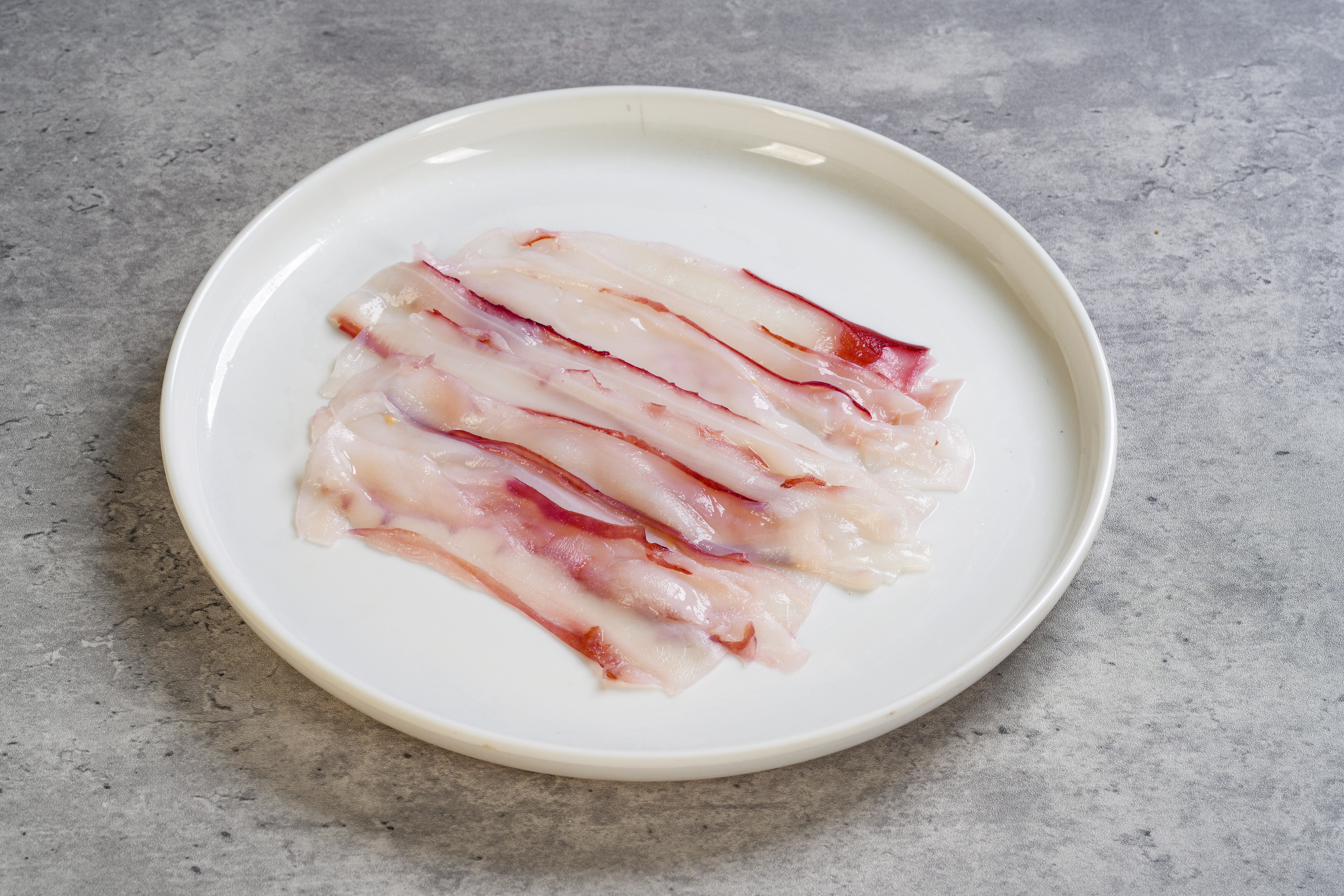
| Form · pack | Specification |
|---|---|
| Paper-thin Squid · 250g/box × 40 boxes | BlockNet weight 100% |
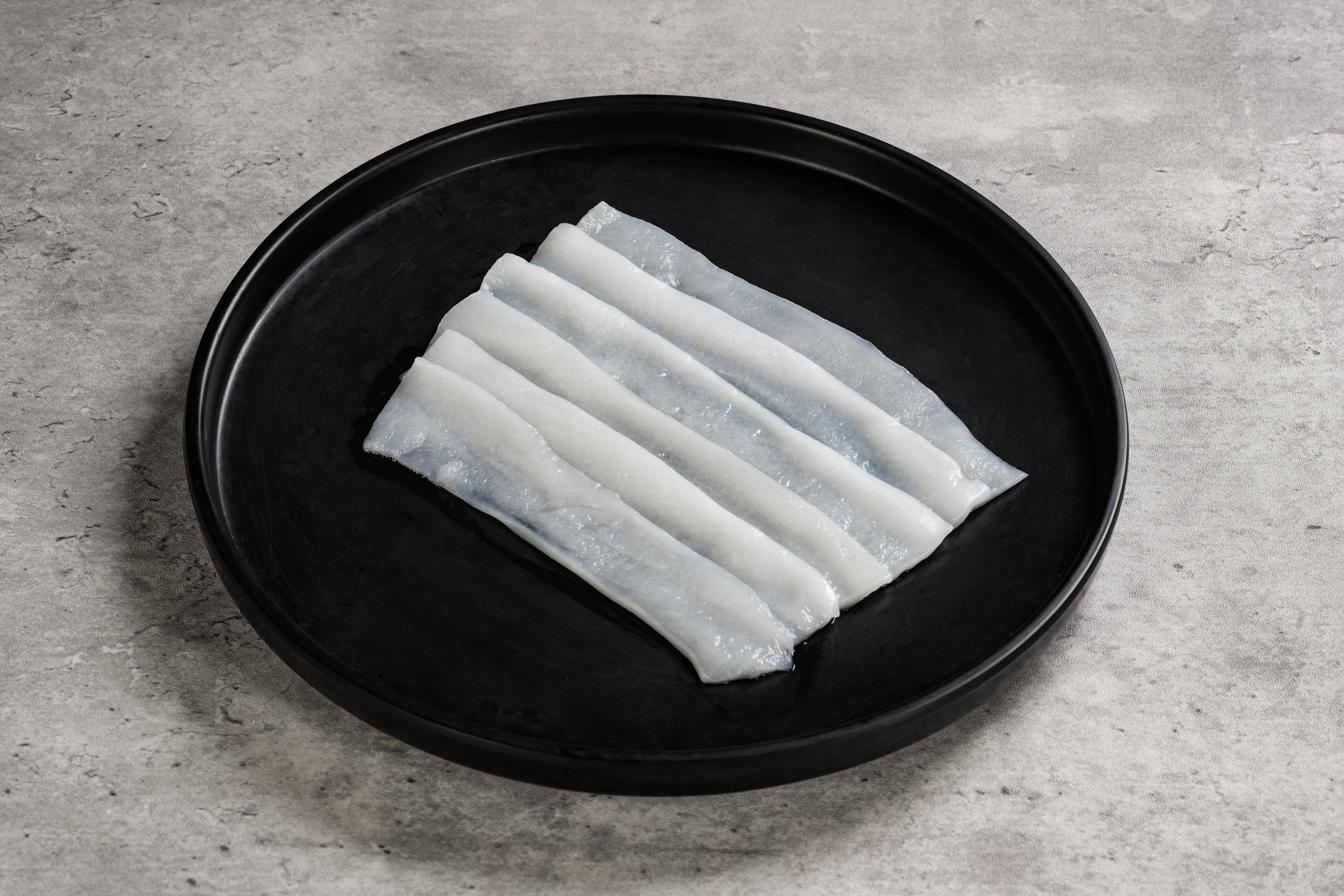
| Form · pack | Specification |
|---|---|
| Hot-pot Squid · 200g/bag × 40 bags | BlockNet weight 100% |
ENSO drives the catch. The fleet adapts.
Gigas is one of the most environmentally-responsive cephalopod fisheries on the planet. La Niña expands habitat and lifts catches; El Niño contracts both. The size-cohort the fleet encounters varies geographically and seasonally — the large adult cohort in the Peru High Seas is divided at vessel into a component supply; the small cohort in the Eastern Equatorial Pacific High Seas is sea-frozen as whole round. Understanding the climate–cohort–fleet relationship is the operational baseline for sourcing this species across cycles.
The ENSO signal in the catch
Gigas habitat suitability and catch volumes correlate strongly with the ENSO cycle. La Niña conditions strengthen Humboldt Current upwelling of cool, nutrient-rich water and expand suitable Gigas habitat — yielding higher catches. El Niño does the opposite: warmer SST contracts suitable habitat and depresses catches, with response time-lags of −1 to 3 months versus the Niño 3.4 index (Yu et al., ICES JMS 2016).
The 2023 record total catch across the Southeast Pacific reached 1.22 million MT — China high-seas fleet + Peru EEZ + Chile EEZ combined — under prevailing La Niña tail conditions. The 2023–24 El Niño event drove a near-50% drop: ~601,500 MT in 2024. 2025 marked a sharp recovery as Niño 3.4 returned to neutral and the resource showed signs of biomass rebuild: Peru's 2025 TAC was raised progressively from 559,804 MT to a final 609,935 MT, with actual landings already exceeding 521,000 MT by early October — nearly triple Peru's 2024 landings (~188,500 MT). The historical record shows similar episodic collapses correlated with strong El Niño events (1997–98; 2009–10; 2015–16), each followed by recovery within 1–2 years. Procurement teams sourcing across cycles benefit from tracking the IRI / NOAA Niño 3.4 index alongside SPRFMO and IMARPE quota signals.
Adult cohort · outside Peru EEZ
Predominates in international waters off Peru (the Peru High Seas), where the Mainland China distant-water fleet we source from operates from May through December. Mature animals can reach 1,000–1,200mm mantle length; the commercial catch commonly runs 4–5kg+ whole weight. Too large to sea-freeze whole, hence the component-supply cut at vessel.
Equatorial cohort · "baby giant"
Predominates in the Eastern Equatorial Pacific High Seas, outside the Ecuadorian and northern Peruvian EEZs, where the Mainland China distant-water fleet we source from operates from January through April. Mature at much smaller size — small enough to sea-freeze as Whole Round. This is the "baby giant squid" supply, sized 300–500g through 2–4kg whole weight, serving whole-fish presentation and downstream processing.
Fleet structure — three principal commercial fleets
2024–2025 · SPRFMO + IMARPE + IFOP| Fleet | Vessels (2025) | Operating area | Latest catch |
|---|---|---|---|
| China distant-water | ~500 activeSPRFMO limit 570 (CMM 18-2026; 671 before); Beijing self-cap of 400 in the Southeast Pacific (2022) | International waters in SPRFMO area outside Peru / Ecuador / Chile EEZs. Industrial jiggers, 50–70m steel vessels with incandescent lamps and mechanical jigger arms. Returned to normal equatorial→Peruvian seasonal rotation in 2025 after the 2024 El Niño-driven anomaly. | 273,900 MT2024 — SPRFMO SC13 (2025); 2024 was a five-year low tracking El Niño. 2025 SPRFMO annual report pending |
| Peru artisanal | ~3,000+ SISESAT-equipped~5,523 eligible total; 280+ now SPRFMO-registered (30-fold surge over 3 years) | Peru EEZ within ~200nm, with growing presence in adjacent international waters following SPRFMO registration push. Wooden vessels averaging 10m, crew of ~6, manually-operated jigger lines. The second-most-important Peruvian fishery after anchoveta. Newly governed by Supreme Decree 003-2025-PRODUCE (ROP). | ~521,000 MT2025 through Oct 1 — IMARPE / PRODUCE; final 2025 TAC raised to 609,935 MT (Oct 24) |
| Chile | Industrial + artisanal mixSPRFMO-reported aggregate | Chile EEZ. Mix of industrial and artisanal vessels with national stock assessment authority under IFOP. Industrial fleet largely sidelined since the 2019 "squid law" excluded it from directed catch; now bycatch only. | ~85,000 MT H12025 through June — IFOP; landing pattern similar to 2024 (139,145 MT full-year); CPUE down 52% in 2025 per Chile SPRFMO report |
Approvals by destination market.
Compliance officers verify approvals against the originating plant. The matrix below lists active destination-market approvals for Dosidicus gigas across our processing facilities. Document framework references on the right.
| Destination market | Approval status | Plant references | Key documents |
|---|---|---|---|
| European UnionEU-27 | Listed; active | BXTW-FAC-17FH0043
BXTW-FAC-27WH0001
BXGC-FAC-33500/02246
|
HCIUU CC |
| South KoreaMFDS | Listed; active | BXGC-FAC-3KR-listed
|
HCChina–Korea FTA CO |
| Japanexport-eligible | Export-eligible | BXTW-FAC-1export-eligible
BXGC-FAC-3export-eligible
|
HC |
| Mainland ChinaGACC | Listed; active | BXTW-FAC-1GACC-listed
|
GACC required documents |
| USA · CanadaFDA · CFIA | Listed; active | BXTW-FAC-1FDA-listed
BXGC-FAC-3FDA-listed
|
HCCOCOA |
| Russia · EAEURosselkhoznadzor | Listed; active | BXGC-FAC-3Russia-listed
|
VC |
| ASEAN11 member states | Listed; active | BXTW-FAC-1ASEAN-eligible
BXGC-FAC-3ASEAN-eligible
|
HCForm E CO |
| Latin Americaper-country | Per-country basis | See market-specific page |
Per-country HC |
Active certifications and listings.
Month-by-month availability.
Gigas operates year-round across origin, with the Mainland China distant-water fleet rotating between two seasonally distinct fishing grounds. The Eastern Equatorial Pacific High Seas (off Ecuador and northern Peru) is fished January through April; the Peru High Seas grounds (international waters outside the Peru EEZ) are fished May through December. Peru and Chile partner-plant raw material and our BXTW/BXGC landfrozen processed product are available continuously.
- The Mainland China distant-water fleet shifts seasonally between the two SE Pacific grounds: Jan–Apr in the Eastern Equatorial Pacific High Seas (off Ecuador and northern Peru, small-cohort whole round); May–Dec in the Peru High Seas (international waters outside the Peru EEZ, large-cohort component supply). Seasonal shift driven by cohort migration and ENSO-modulated habitat.
- Peru EEZ partner-plant operations run under the annual quota set by PRODUCE on IMARPE advice (499,683 MT in 2024; 609,935 MT final TAC for 2025; 709,659 MT for 2026 under RM 00304-2026-PRODUCE) with quota allocation rolled out by serial PRODUCE Ministerial Resolutions through the year. The fishery is newly governed by Supreme Decree 003-2025-PRODUCE (ROP), replacing decade-old regulations and mandating SISESAT satellite tracking and SITRAPESCA traceability. Chile EEZ partner plants operate under SUBPESCA management, advised by IFOP.
- Landfrozen processed product (BXTW-FAC-1 + BXGC-FAC-3) draws from buffer inventory at both processing facilities — buyers can specify raw-material origin (Mainland China sea-frozen or Peru/Chile partner-plant) at the inquiry stage.
Recent Dosidicus gigas research.
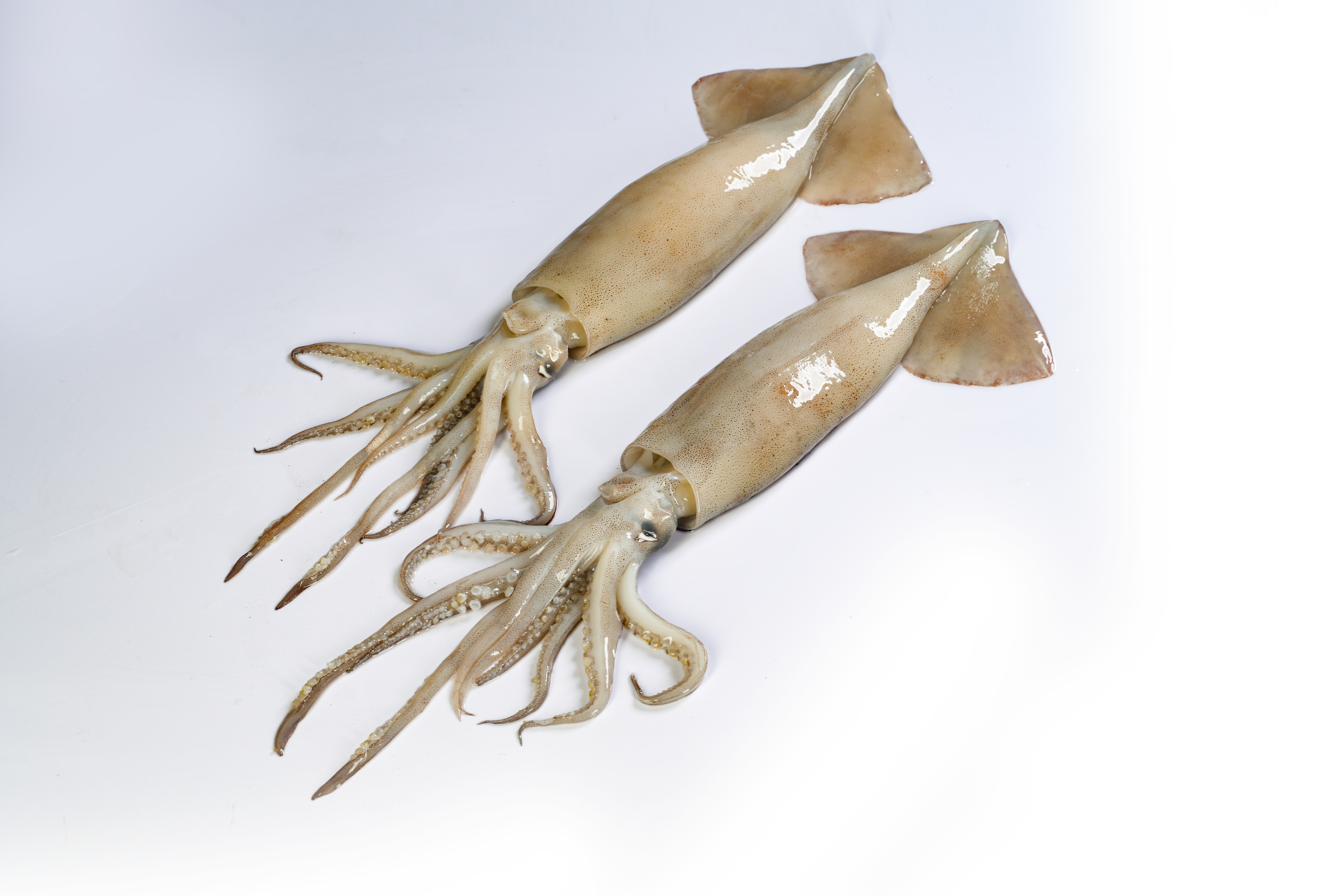
Source Dosidicus gigas
from Baixian Trade.
Whether you are sourcing for North American foodservice, East Asian retail, European seafood distribution, Latin American markets, or specialty processing — our analysts respond in your language and quote within 48 hours. Specify origin (Mainland China sea-frozen component supply or equatorial whole round; Peru/Chile partner-plant raw material; BXTW Calamari Steak; BXGC processed), form, grade, and destination port — we'll come back with current pricing and lead time.